what is the easiest way to get more space back on my windows 8.1 hard drive
No affair how big a difficult drive or solid-state drive you take in your PC or laptop, there will come a time when you run out of infinite. If yous're bumping up against your PC'south physical storage limit, hither are some quick tricks you can use to repossess a couple of gigabytes' worth of storage space. These options will take you only then far; if yous demand more than free infinite after following these tips, y'all may demand to add a second hard bulldoze or supervene upon your current bulldoze with one with more storage capacity.
With that caveat, here are eight tips for reclaiming some bulldoze infinite on your Windows PC or laptop.
Empty the Recycle Bin
When you delete items, like files and photos, from your PC, they don't immediately get deleted. Instead, they sit in the Recycle Bin and continue to take upwardly valuable difficult-drive infinite. To empty the Recycle Bin, get to your desktop, right-click on the Recycle Bin and click Empty Recycle Bin. You volition come across a alarm pop-up asking if y'all are sure y'all want to permanently delete your Recycle Bin items. Click Yes to continue.
Disk Cleanup
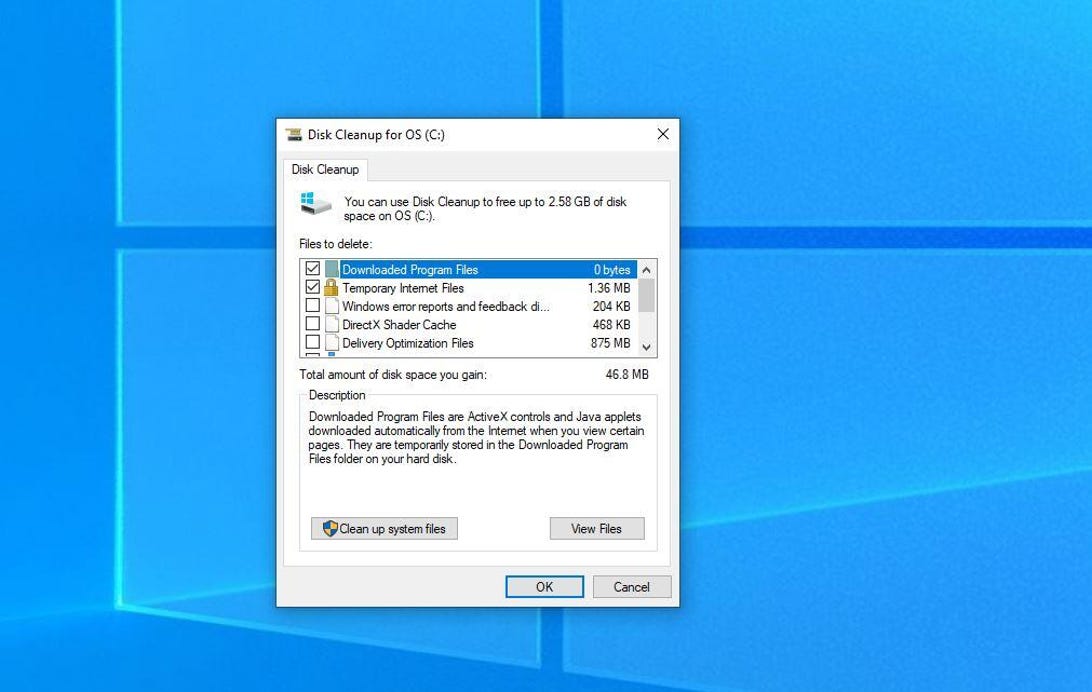
Windows has a built-in disk cleanup utility, aptly named Disk Cleanup, which tin can help you clear upwards space by removing various files -- including temporary internet files, arrangement mistake memory dump files and even previous Windows installations that may yet be hanging around.
Y'all can observe Disk Cleanup in the Showtime card under Windows Authoritative Tools > Disk Cleanup or you can just search for it. Select the file types you want to delete -- from Downloaded Program Files to Thumbnails -- and hit OK. If you're unclear about what files are included for each item listed, click the View Files push to check earlier proceeded. And if you desire to delete system files, such as theWindows.old folder (which holds your previous installations of Windows, and can be several gigabytes in size), click Clean up system files.
Delete temporary and downloaded files
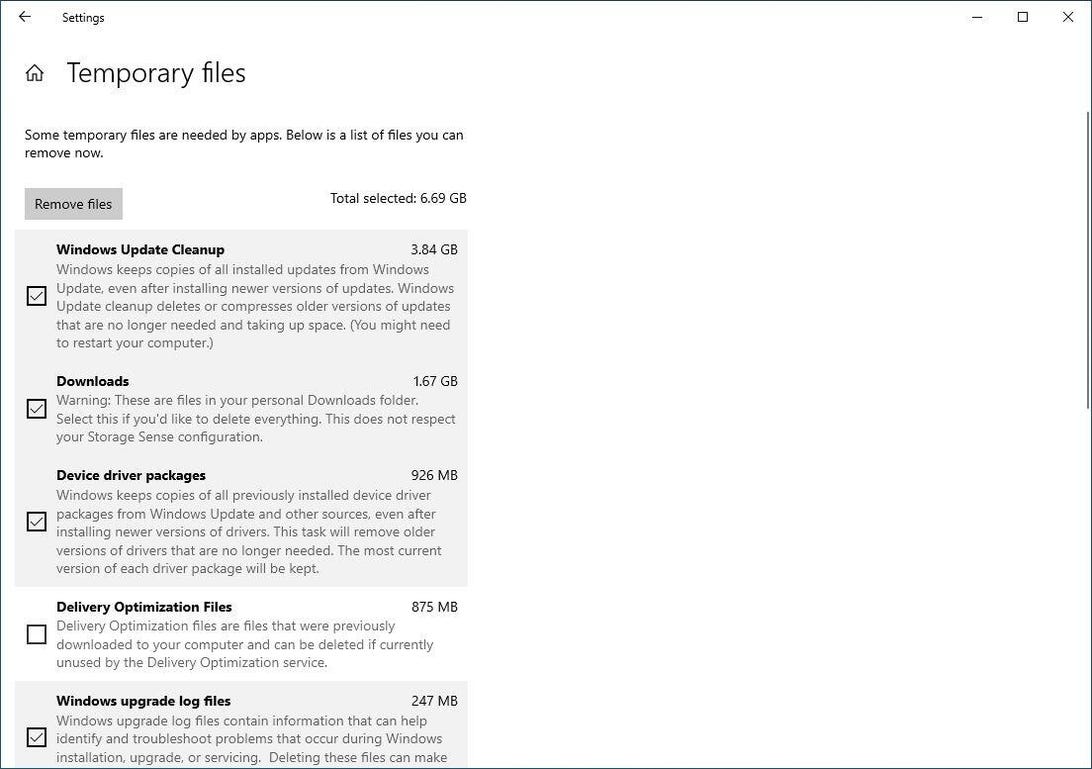
You can delete temporary files without running Disk Cleanup, forth with files you downloaded that you lot may no longer need. Go to Settings > System and click on Storage on the left panel. Adjacent, click Temporary files from the list that shows you how your storage is existence used on the C: drive and check the boxes for the type of temp files you want to jettison before clicking the Remove files button to delete them.
Turn on Storage Sense
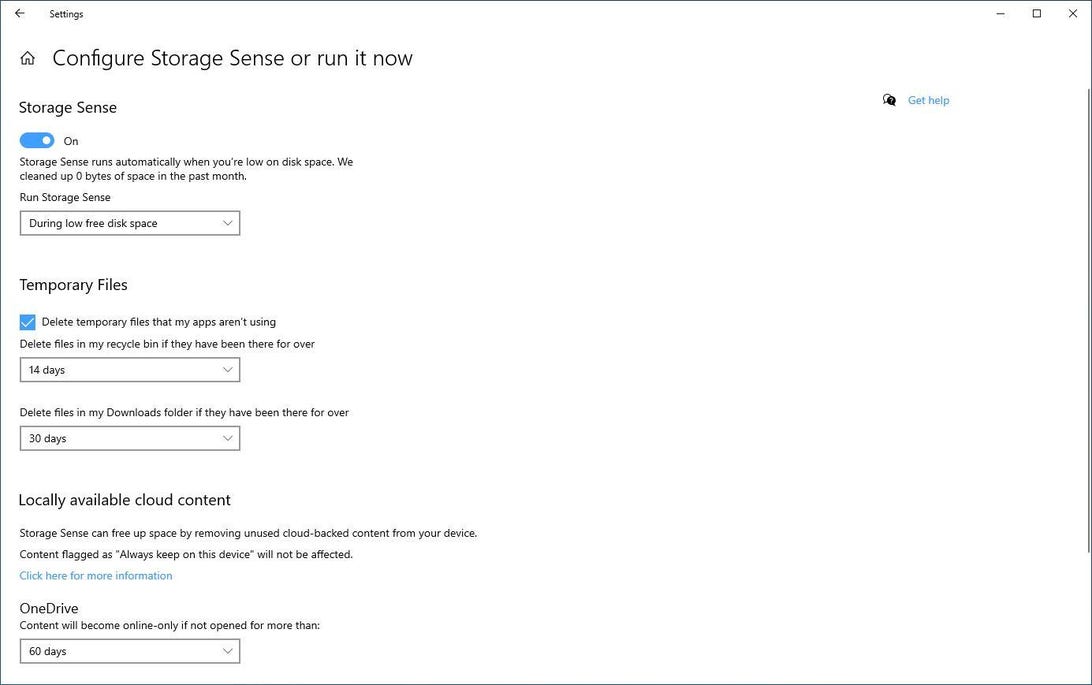
You can automate some of this cleanup by heading back to the Storage page in Settings and toggling on Storage Sense. You tin set it and so Windows automatically deletes unused temporary files, as well as files that have been in the Recycle Bin and Downloads binder for more than than a day or up to 60 days. You lot can likewise choose to move local files off your PC and to the cloud via OneDrive if they haven't been opened for a specified period of time. I'm pretty skillful nigh emptying the Recycle Bin on something approaching a regular schedule, only I'k also very happy to have Windows rail downwards and eradicate needless temp files and erstwhile downloads.
Relieve files to a different bulldoze
If your reckoner has multiple hard drives or a partitioned hard drive, you may observe yourself running out of infinite on one bulldoze (or sectionalization). Luckily, you lot can set this by changing your default relieve locations for apps, documents, music, pictures and videos. To do this, open up the Settings menu and go to System > Storage and click the link at the bottom for Change where new content is saved. You tin select a partition or a drive -- even a removable drive, like a USB flash bulldoze or a memory card -- that is continued to your PC to relieve files for categories including apps, documents, music, photos and movies.

Disable hide
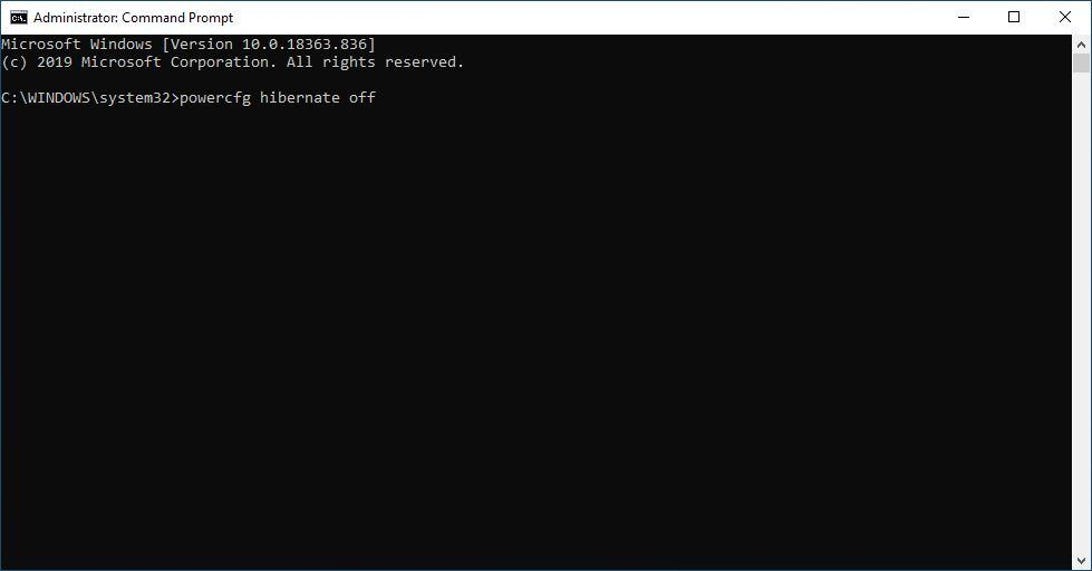
Instead of shutting down your calculator completely, you tin put it in hibernate, a quasi-close-downwards state that allows the calculator to start up faster. When your computer goes into hibernate, it saves a snapshot of your files and drivers before shutting downward, and this takes up infinite. If starting up quickly isn't your priority, you can reclaim some valuable hard drive space by disabling hibernate altogether, because the hiberfil.sys file can take up gigs of drive infinite.
Click the Beginning button and search for Command Prompt. Right-click Control Prompt at the peak of the search results and select Run as ambassador. In the Command Prompt window, enter: powercfg /hide off and so hit Enter. (If y'all miss hibernating, you can utilise control: powercfg /hibernate to re-enable the characteristic.)
Uninstall apps
You probably have some apps and programs on your PC that you don't use -- either apps you've installed and forgotten well-nigh, or bloatware that came preinstalled on your computer from the manufacturer. To find out which apps are taking up space, open the Settings menu and go to Apps > Apps & features and choose Sort by size. To uninstall an app from this menu, click the app and then click Uninstall.
If you're running legacy programs on Windows x ($147 at Amazon), you may not see them in this listing (some appear, simply some exercise not). To notice these, openControl Panel by searching for it from the Start menu. UnderPrograms, click Uninstall a program to see a list of the legacy programs on your estimator (you can also sort this list by program size). To uninstall a program from this list, left-click information technology to select it and click theUninstall button at the top of the list.
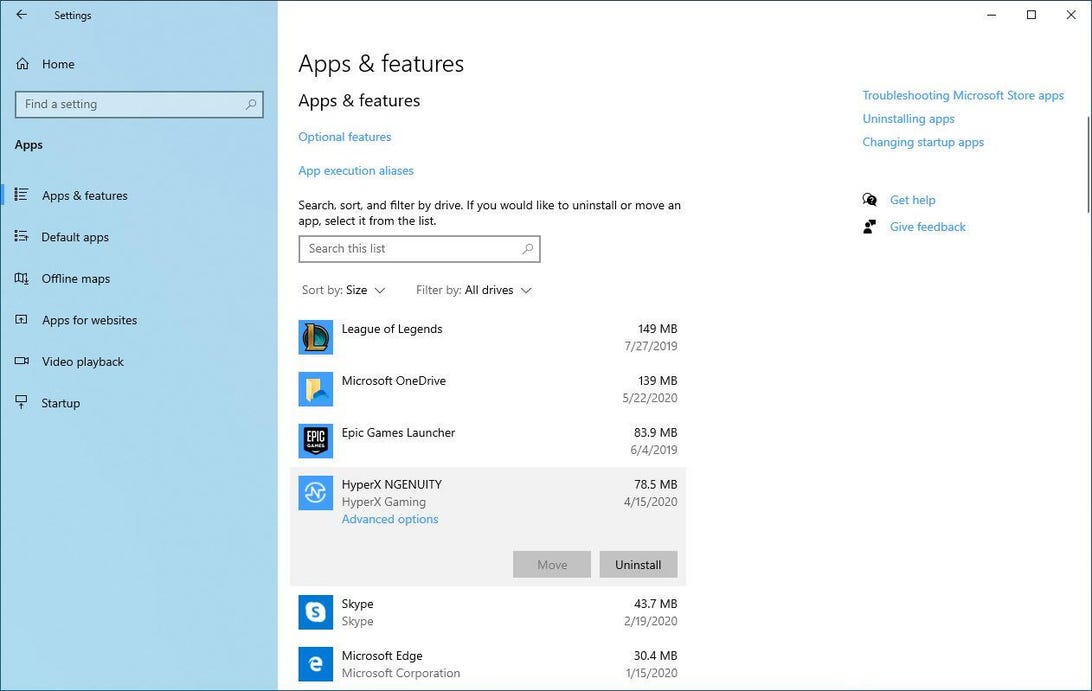
Store files in the cloud -- and only in the cloud
If you take reward of cloud storage via OneDrive or another service, you're probably double-storing files and photos. Well, you lot don't have to do this -- all cloud storage services allow you to select which folders are downloaded and saved to your PC (every bit well every bit in the cloud).
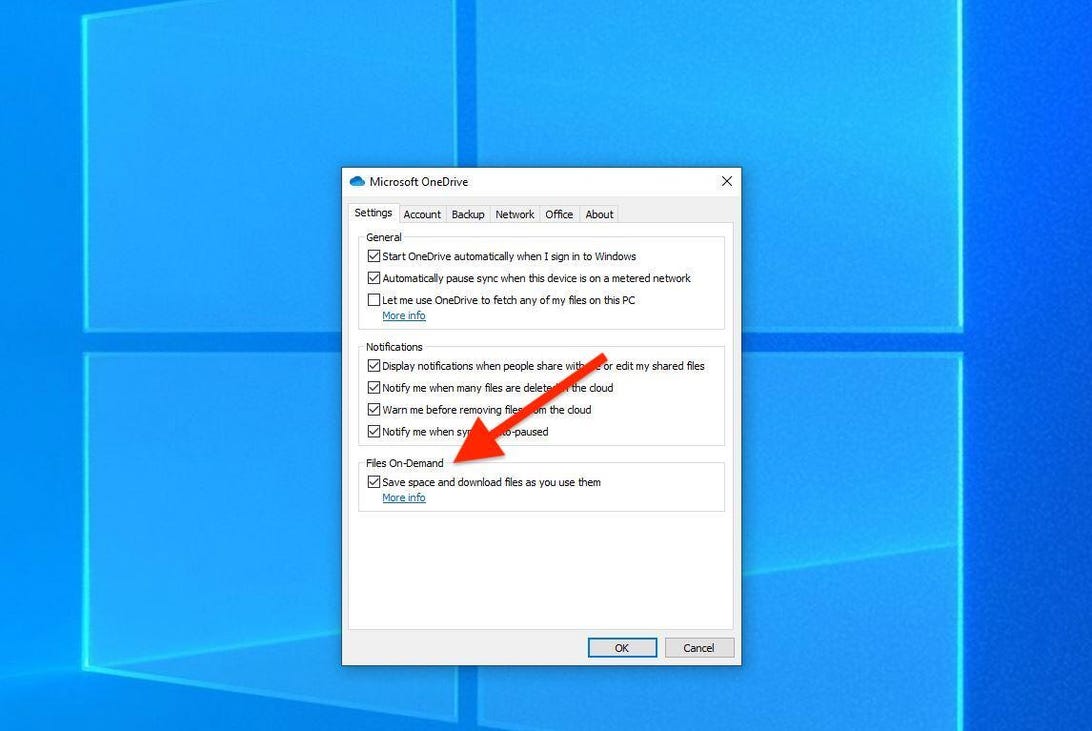
If you use OneDrive, here's what to exercise: Right-click on the OneDrive icon in your system tray and cull Settings. In the Settings tab, check the box for Salvage space and download files as you use them. This setting will let you see the files you have stored in OneDrive from File Explorer on your PC, which pulls off the great trick of showing you all of your local and cloud-based files in ane spot. In File Explorer, you'll see 3 different icons for OneDrive files in the Condition column:
- Blue deject:online-only file
- Green checkmark in white circle: locally stored file that might revert dorsum to online when you run short on space
- White checkmark in green circle: locally stored file that volition stay put, no matter how short on space you get
You can easily move OneDrive folders and files to your PC and back again. To move a file or folder stored in OneDrive to your PC, correct-click it and select Always proceed on this device. To remove the local copy of the file or binder and have information technology stored only on OneDrive, right-click information technology and choose Free up space.
mcdonaldruess1936.blogspot.com
Source: https://www.cnet.com/tech/services-and-software/quick-ways-to-free-up-drive-space-in-windows-10/
0 Response to "what is the easiest way to get more space back on my windows 8.1 hard drive"
Post a Comment